
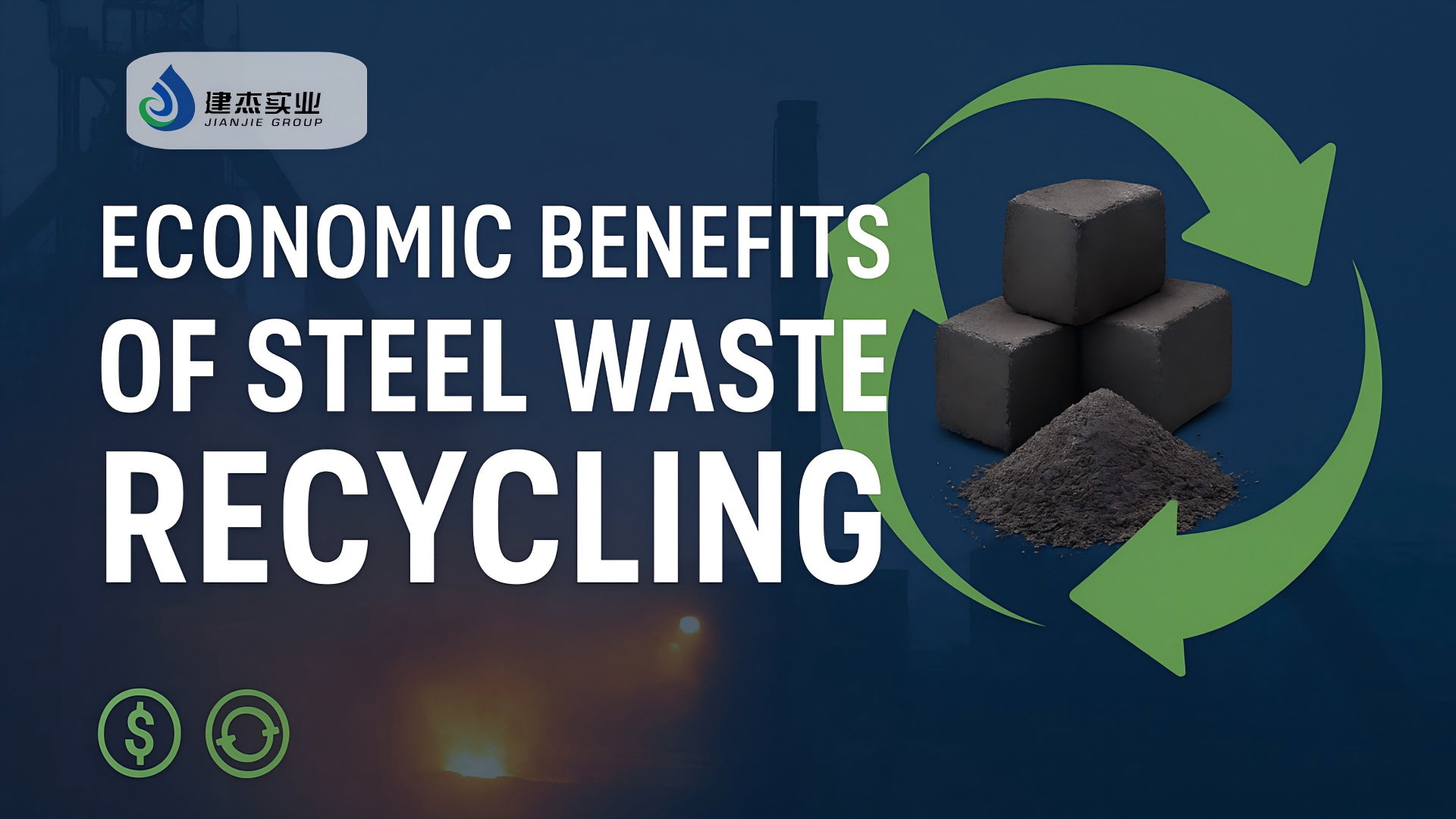
Steel production generates large volumes of by-products such as mill scale, EAF/BOF dust, sludge, and slag. Traditionally, these steel waste are either landfilled or stored, which not only takes up space but also creates additional disposal costs and environmental concerns.
As one of the most efficient and practical Steel waste recycling methods, cold briquetting technology offers a sustainable solution: transforming steel waste into strong, durable briquettes that can be reused in steel production. Beyond the environmental benefits, this process delivers significant economic advantages for steel plants.

This article explores the economic advantages of steel waste recycling through Briquetting and highlights how Jianjie’s specially developed high-performance binders for steel waste, helping steel mill achieve both economic and environmental benefits.
What is Steel Waste Recycling?
Steel waste recycling refers to the process of recovering and reusing by-products generated during steelmaking, such as dust, الحمأة, mill scale, and slag. Instead of being disposed of as waste, these secondary materials are treated and transformed into resources that can be reintegrated into steel production, thereby improving resource efficiency and minimizing environmental impact.
Compared tranditial agglomeration methods, briquetting offers a more energy-efficient and cost-effective approach. By using specially industrial binders, steel waste are compacted at room temperature into high-strength briquettes. This method not only reduces energy requirements compared with traditional processes but also enhances the adaptability of recycling across different types of steel waste.
.
From Steel Waste to Briquettes, From Steel Waste Recycling to High-Value Benefits
Economic Benefits for Steel Production
Reduced Raw Material Costs
Every ton of steel requires significant amounts of iron-bearing raw materials, which are costly to purchase on the market. Steel waste briquettes give steel plants the ability to recycle their own by-products back into the furnace. By replacing part of the ore burden with these briquettes, steelmakers can cut down on raw material purchases and ease their reliance on imported iron ore, turning what was once waste into a valuable resource.
Lower Waste Disposal Expenses
Solid waste disposal is not only a logistical challenge but also a financial burden. Landfilling and treatment come with recurring fees, and in some regions, failing to manage steel waste properly may even result in environmental penalties. Briquetting offers an alternative pathway: instead of paying to discard by-products, steel plants can convert them into useful furnace feedstock. This shift turns waste management from a constant cost into an investment that brings long-term returns.
Savings in Transportation and Storage
Handling fine powders is messy and inefficient. They generate dust, occupy large storage volumes, and are difficult to transport without significant loss. Once transformed into briquettes, however, these same materials become compact, stable, and easy to handle. Higher bulk density means reduced transportation costs, while cleaner, stackable briquettes save valuable yard space and simplify warehouse logistics.
Improved Energy Efficiency in Smelting
When fine powders are charged directly into a furnace, a large fraction is lost in the gas stream before it can even contribute to the process. Briquettes solve this problem by holding together under high temperatures, ensuring that the iron content is fully utilized. This not only prevents resource losses but also reduces fuel consumption and energy waste, leading to smoother, more efficient furnace operations.
Additional Value from By-Products
Some steel waste streams contain elements of hidden value. For instance, electric arc furnace dust often holds significant amounts of zinc. Through processes such as rotary hearth furnace (RHF) dezincification, these elements can be extracted and sold as by-products. What was once considered a disposal problem can now generate new revenue, supporting circular economy practices and creating an additional profit stream.
Environmental and Policy-Driven Benefits
The use of steel waste قوالب الفحم الحجري not only creates economic value but also delivers significant environmental advantages. By recycling dust, sludge, and mill scale into briquettes, steel plants can reduce landfill disposal and minimize hazardous waste storage. This contributes to cleaner production and helps conserve valuable natural resources by replacing part of the virgin raw materials.
Environmental regulations increasingly mandate recycling of steel production by-products to cut carbon footprints and boost resource efficiency. Briquetting technology helps companies stay compliant, enhance sustainability, and improve their ESG profile, strengthening global competitiveness.
Steel Waste Recycling: Turning Waste into New Value with Jianjie Binders
Jianjie provides specialized briquette binders tailored for different steel waste, ensuring strong bonding, high mechanical strength, and excellent metallurgical performance.
Applicable Materials in Steel Waste Recycling
Mill Scale
Rich in Fe content, suitable for recycling into the furnace.

Jianjie Binder for Mill Scale
Steel Slag
Difficult to handle due to low adhesion, but effectively briquetted with Jianjie binder.

Jianjie Binder for Steel Slag
Converter Dust / EAF Dust
Fine particles containing Fe, Zn, and Pb; cold-bonding makes recycling feasible.

Jianjie Binder for EAF Dust
الحمأة
High moisture content, requiring special binder design for stable shaping.
Sinter Return Fines
Recycled efficiently into blast furnace feed.

Jianjie Binder for Sinter Return Fines
Superior Advantages of Jianjie’s Binders in Steel Waste Recycling
Produces durable briquettes that resist breakage and maintain stability throughout the steel production.
With Jianjie’s binder technology and technical support, every step from binder development and production to final application undergoes strict quality control and testing, ensuring each batch delivers maximum performance. This helps steel plants fully realize both economic and environmental benefits, transforming steel wastes into stable, high-quality production resources.

Briquettes Cold Compression Strength Test
Conclusion
Steel Waste Recycling through Briquetting converts Steel Waste into high-strength secondary raw materials. With appropriate binder formulations, the briquetting process improves particle adhesion, enhances briquettes stability, and enables efficient steel waste recycling in furnaces.
To learn more or get expert guidance, contact Jianjie anytime, as our specialists are ready to answer your questions and support your steel waste briquetting needs.


 Arabic
  English
  Chinese
  Russian
  Indonesian