
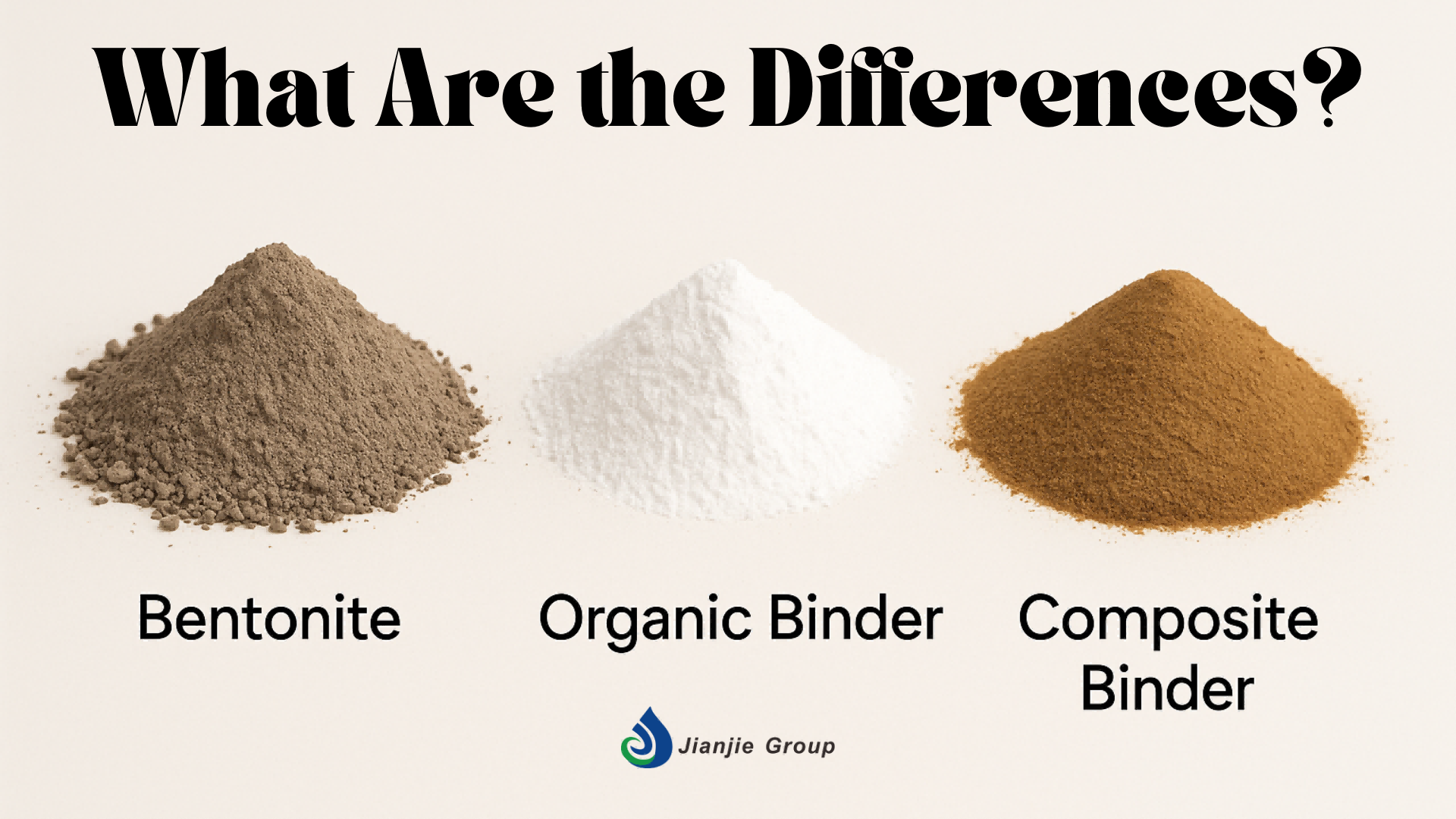
Iron ore pelletizing is a critical process in steelmaking, transforming fine iron ore into strong, durable pellets. A key factor in this process is the binder—a substance that helps hold the granules and particles together during pellet formation (pelletization), drying, and firing. Among the many binder options, bentonite binder has been the traditional choice. However, alternatives like organic binders and composite binders like Jianjie binder are gaining attention due to their performance and sustainability benefits.

In this article, we compare bentonite binder with modern alternatives and examine how different binder types impact pellet strength, iron grade, and overall pelletizing performance.
How Does Binder Work in Iron Ore Pelletizing?
In the pelletizing process, binders are added to iron ore fine to help bond the particles and to create high-strength pellets suitable for blast furnace or direct reduction use.
Binders are essential for pelletizing iron ore fines and the pellet quality. For example, they enhance the mechanical strength and durability of pellets, making them suitable for transportation and use in steel production. Without binders, the powdered product can’t hold together and would break apart easily, reducing the efficiency of the entire pelletization process.
The choice of binder can significantly affect the quality, cost, and efficiency of iron ore pellet production.
A good binder need to:
- Provide green strength (wet strength for green pellet shaping)
- Maintain pellet integrity during drying
- Enable thermal bonding during preheating and firing
- Minimize impurities to preserve the iron grade of pellets
What is Bentonite Binder: Strength with Trade-offs
You may heard of bentonite clay when it comes to cat litter. However, bentonite is also a naturally occurring clay material that has been widely used as a binder in pelletizating for many years. It has excellent binding properties due to its high moisture retention and expansive nature
Advantages of Bentonite Binder
- Cost-effective: Bentonite is inexpensive and readily available, making it a popular choice for pelletizing iron ore.
- Widely available: Bentonite can be sourced from various suppliers.
- High wet and dry pellet strength
- Good thermal resistance and thermal strength: the components (silica (SiO₂) and alumina (Al₂O₃)) in bentonite will greatly increase the decrepitation temperature of pellets. Decrepitation temperature is an important indicator of a qualified iron ore pellets.
Disadvantages of Bentonite Binder
However, bentonite binder introduces undesirable gangue components such as silica (SiO₂) and alumina (Al₂O₃) into the pellet, which can:
- Lower the iron content of the final pellet
- Silica and alumina in bentonite will increase flux demand (limestone, dolomite)
- Increase slag volume in steelmaking
- Higher slag volume, energy consumption, and smelting difficulty
- The SiO2 in bentonite will reduced metal recovery
What is Organic Binder: Cleaner But Weaker
To address contamination issues, organic binders like carboxymethyl cellulose (CMC), starch, lignosulfonates, and humic substances are increasingly used in iron ore pelletization. These binders offer:
- Zero residual impurities after firing
- Higher iron content in pellets
- Lower impact on metallurgical performance
- Environmentally friendly
However, organic binders alone often struggle to deliver the required dry and thermal strength, especially at high temperatures. Without forming a liquid bonding phase during firing, pellets made with organics may lack the mechanical integrity needed for transport and smelting.
Composite Binders: Optimizing Strength and Purity
Composite binders combine the strengths of both bentonite and organic binders. These formulations are designed to:
- Enhance wet and dry strength using organic components
- Promote thermal bonding through inorganic additives
- Reduce binder dosage and gangue content
Jianjie Binding Solution: Enhanced Strength with Lower Dosage
Jianjie binder for iron ore pellets is specially developed for iron ore pelletizing applications. Among the binder products, Jianjie organic binder is a polymer-based organic binder.
It features:
- No toxic or hazardous substances, aligned with green production goals
- High binding efficiency at low dosages
- Increase Fe grade and metallurgical quality
Compared to only using bentonite, Jianjie binder requires far less material while maintaining green strength, dry integrity, and fired durability—making it a smart choice for high-performance pellet plants.
PS. The specific dosage of Jianjie organic binder depends on the specification of bentonite used and quality of iron ore fines.
| Metric | Jianjie Binder + Bentonite | Bentonite Only |
| Binder Dosage | With 0.05–0.15% Jianjie organic binder can lower a lot of the addition of bentonite | 0.6–1.7% Bentonite |
| Green Pellet Drop Strength (0.5 m) | ≥6 times | 4–5 times |
| Dry CCS | ≥50 N | Lower |
| Pellet Fe Grade | Higher With every 1% decrease in the use of bentonite, the Fe grade can increase 0.6% | Lower |
| Ash Content | Low | High |
| Balling Rate / Productivity | +10% | Lower |
| Feeding Speed | Faster | Slower |
| Labor Cost | Lower (due to low dosage) | Higher |
Real Case: Mid-Eastern Iron Ore Pelletizing Plant

Qualified Iron Ore Pellets
One of our customers in the Middle East originally used 0.3% bentonite as binder. However, the pellets are weak and can’t reach the ideal strength. They found us and their goals were to:
- Reduce bentonite dosage
- Maintain wet pellet drop strength (maintain intact after falling from the height of 0.5m twice)
- Improve cold compressive strength (CCS ≥ 300 kg)
Solutions: The quality of bentonite and iron ore fines used by clients were high. Therefore, we were able to also lower the amount of Jianjie binder. Here Are the Trial Results (Bentonite + Jianjie Organic Binder) Provided by Jianjie:
Outcome: By reducing bentonite to 0.15% and adding just 0.03% Jianjie Binder, the client achieved over 49% improvement in CCS while reducing labor and material costs.
| Formula | Bentonite | Jianjie Organic Binder | Drop Strength (0.5 m) | CCS (kg) |
| Binder 1 | 0.3% | 0% | 2 times | 226 |
| Binder 2 | 0.25% | 0.028% | 3 times | 236 |
| Binder 3 | 0.18% | 0.02% | 2 times | 267 |
| Binder 4 | 0.15% | 0.03% | 2 times | 338 ✅ |
Choose the Right Binder for Iron Ore Pelletizing
Both bentonite and organic/composite binders play important roles in iron ore pelletization. Bentonite is a cost-effective and widely available option, but it can increase the silica content in pellets and contribute to environmental challenges.
Organic and composite binders, while more expensive, offer superior pellet quality, reduce impurities, and are more environmentally friendly.
In modern iron ore pelletizing plants, binder selection can significantly affect operational efficiency, product quality, and environmental compliance. Here’s how to choose:
- Use bentonite binder for low-cost operations where pellet purity is less critical.
- Choose organic binders for high-purity pellets—but account for strength limitations.
- Adopt composite binders like Jianjie Binder for the best of both worlds: high strength, low impurity, improved Fe content, and cost-effective dosage.
As steelmakers move toward low-carbon, high-efficiency processes, binder innovation will be key to unlocking pelletizing performance.
The choice of binder will depend on the specific needs of the pelletization process, balancing factors such as cost, performance, and sustainability. Future research into more efficient and eco-friendly binders will likely shape the future of iron ore pelletizing and steel production.
If you are interested in our binder products for iron ore pellets and service, please feel free to contact us!

 English
  Arabic
  Chinese
  Russian
  Indonesian