
The global steel industry produces over a billion tons of steel annually—alongside it comes an enormous volume of by-products such as steel dust, mill scale, and, notably, steel slag. Historically treated as industrial waste, slag from steel mills is now gaining recognition as a valuable secondary resource due to its rich chemical composition and diverse reuse potential.

Environmental Threats of Unutilized Steel Slag
What is Steel Slag?
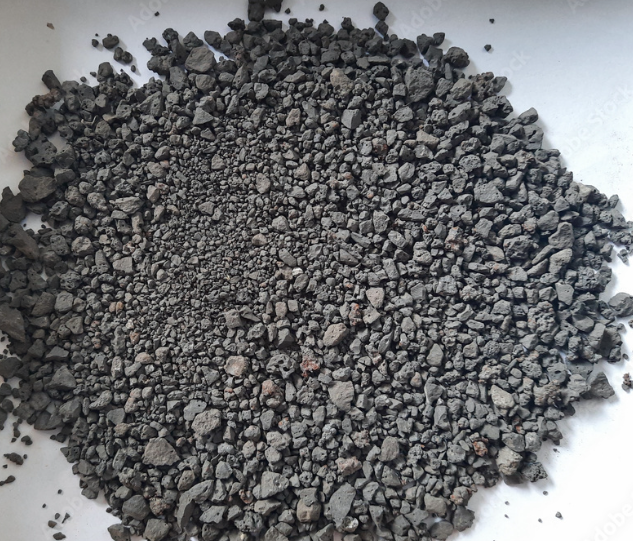
Steel SLag
Steel slag is a solid by-product formed during steelmaking when impurities are separated from molten steel. Common types include Basic Oxygen Furnace (BOF) slag, Electric Arc Furnace (EAF) slag, and Ladle Metallurgy Furnace (LMF) slag.
Steel slag is a solid by-product formed during steelmaking when impurities are separated from molten steel. It includes blast furnace slag, electric arc furnace slag (EAF), basic oxygen furnace slag (BOF), and ladle metallurgy furnace (LMF) slag. Steel slag has good compression resistance. The bulk density of steel slag is 3.1-3.6g/cm3, and the moisture content of steel slag is 3-8%. While chemical composition varies, it generally contains high levels of oxides like CaO, FeO, SiO2, Al2O3, MgO, and MnO—making it suitable for diverse reuse strategies.
Chemical Composition in Steel Slag:
| Components | Content |
| Calcium oxide (CaO) | 40-60% |
| FeO | 14-21% |
| Magnesium oxide (MgO) | 3-10% |
| Manganese oxide (MnO) | 1-8% |
| SiO2 | 8-15% |
| Al2O3 | 7-12% |
Types of Slag from Steel Mills and Their Characteristics
Slag generated during steel production varies depending on the steelmaking process and furnace type.
1. Blast Furnace Slag (BFS)
Blast furnace slag is formed during the production of pig iron in a blast furnace. It results from the reaction between gangue (impurities in iron ore or binder) and fluxes like limestone. Granulated blast furnace slag (GBFS) is the grounded blast furnace slag.
2. Basic Oxygen Furnace (BOF) Slag/ Converter Slag
BOF slag, aka converter slag is produced during the primary steelmaking process where oxygen is blown into molten iron to remove carbon and impurities.
3. Electric Arc Furnace (EAF) Slag
Stainless steel and carbon steel are the two main products of steel plants with electric arc furnace. During the production, slags form in EAF slag forms during the melting of scrap steel in an EAF.
4. Ladle Metallurgy Furnace (LMF) Slag
Also known as secondary refining slag, LMF slag is formed during the adjustment of steel’s final chemical composition in the ladle. It’s usually more fine-grained and glassy.
Reuse of Steel Slag in Steel and Ironm Making: From Waste to Value
Steel slag is an important waste resource that can be reused in various industries and fields, including construction, steel plants, sintering, agricultural fertilizer, etc. Though steel slag is formed during the ironmaking and steelmaking processes, it can be reintroduced into the processes as a valuable resource. For example, slags with metallic iron can be recovered using magnetic separation, improving resource efficiency. The remaining slag also serves various uses:

Cooling agent in BOF to absorb heat.
As a flux in ironmaking: allowing for the recovery of iron from the slag, reducing the consumption of fluxing agents, improving utilization efficiency, and lowering costs.
As a sintering additive: Replacement for fluxes in sintering, When the CaO content is relatively high, steel slag can be used as a fluxing agent in sintered ore to partially replace lime.
How to Reuse Steel Slag – Briquetting Slags
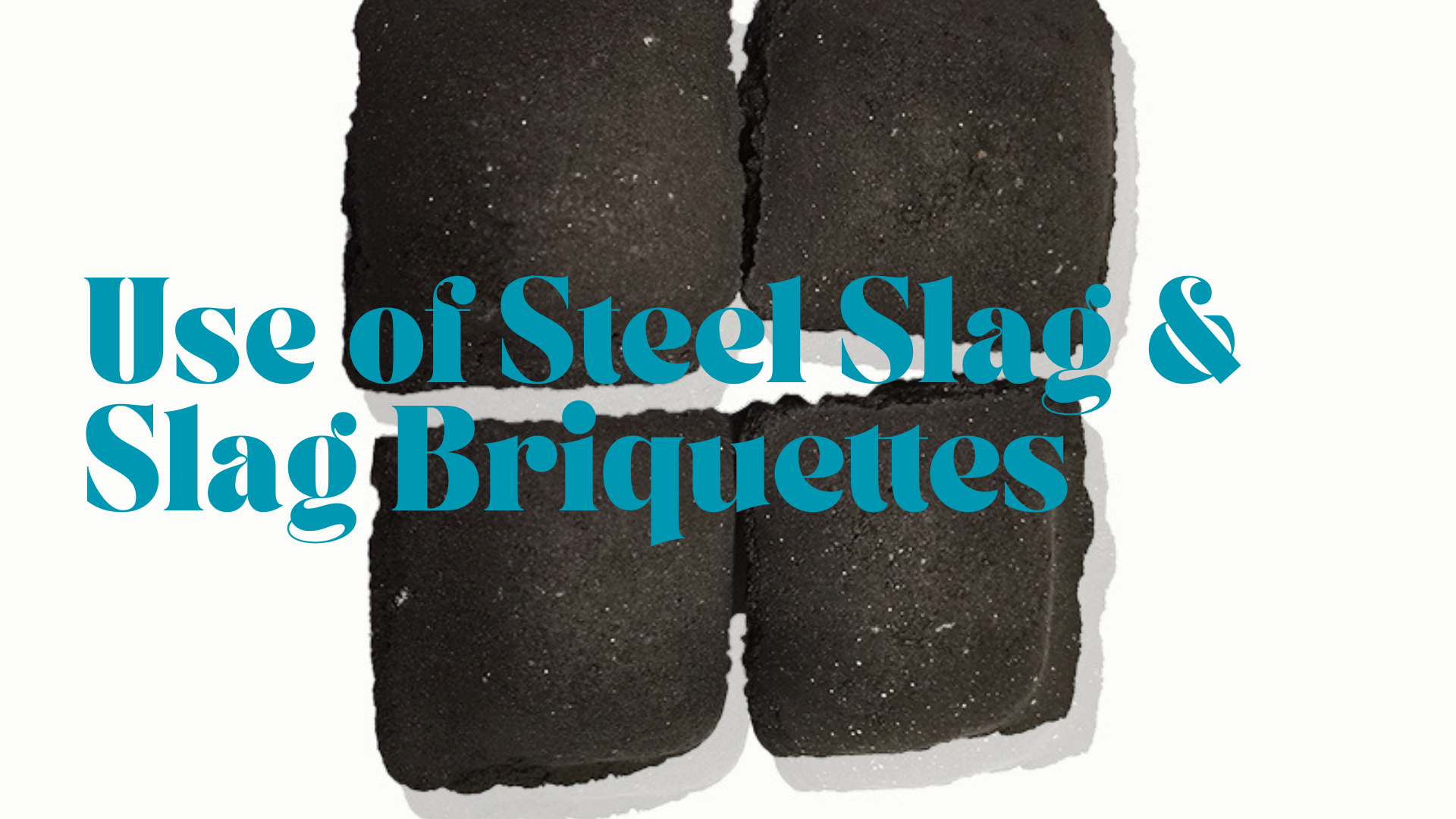
Steel slag briquetting plays a key role in promoting the reuse of steel mill waste and building a circular economy in steel production. Briquetting is an efficient way to convert fine furnace slag particles into solid, manageable briquettes that are easy to transport and reintroduce into the furnace.
Benefits of Briquetting Steel Slag:
- Reduces dust and material loss during transportation and handling
- Stabilizes free lime (CaO) content: CaO in steel slag
- Enhances material density and cohesion
What is Steel Slag Briquette? What Makes a Good Steel Slag Briquette?
A steel slag briquette is a compact, solid form made by compressing fine slag from steel mills—especially furnace slag—into uniform shapes. These briquettes are specifically engineered to be transport-friendly, mechanically strong, and furnace-compatible, making them easier to handle, store, and reuse in high-temperature industrial processes.
To be effective and reusable, a good steel slag briquette must meet several performance standards:
✅ High compressive strength: Able to withstand pressure during storage, transport, and furnace charging
✅ Low water reactivity: Minimizes cracking or disintegration due to residual free CaO (quicklime)
✅ High thermal resistance: Must remain intact under high-temperature furnace conditions
✅ Stable structure: Should not expand or crumble due to moisture or chemical reaction
✅ Consistent shape and density: Facilitates automated handling and furnace feeding systems
Producing such briquettes requires precise slag preparation, process optimization, and, most critically, the right binder formulation.
How Can Binder Influence the Quality of Steel Slag Briquettes?
Binder selection is one of the most crucial factors in determining the success of steel slag briquetting. Given the low natural cohesiveness and variable chemical composition of different types of steel slag, binders act as the “glue” that holds the particles together and ensures the final briquette is both strong and stable.
Here’s how a binder affects slag briquetting:
1. Stabilizing Free Lime (CaO)
Some slags, especially BOF slag, contain high amounts of free CaO. When exposed to moisture, free CaO reacts and expands, leading to cracks and volume instability. A high-performance binder can chemically neutralize or encapsulate free lime, reducing reactivity and improving long-term stability.
2. Improving Briquette Strength
Binders enhance the compressive and drop strength of briquettes by improving particle adhesion. For slags with high Fe content (like EAF slag), a binder can help offset the lack of natural plasticity and improve structural integrity.
3. Optimizing Furnace Compatibility
The binder should introduce less harmful impurities or interfere with furnace operations. Ideally, it contributes to slag fluidity or adds beneficial components to the melt.
4. Customization Based on Slag Chemistry
No one-size-fits-all binder works for all slags. For optimal results, custom binders—like those developed by Jianjie—can be tailored based on lab analysis of slag composition. This ensures chemical synergy between slag particles and binder components, reducing issues like dusting, cracking, and expansion.
Ready to Upgrade Your Steel Slag Recycling Strategy?
If you’re facing challenges like briquette cracking, low strength, or free CaO reactivity, Jianjie offers customized binder solutions tailored to the unique chemical properties of your slag.
Contact our specialists today for a personalized consultation and begin turning your slag waste into profit.
Frequently Asked Questions about Steel Slag and Its Reuse
1. Can all types of slag from steel mills be reused?
While most types of slag—including BOF slag, EAF slag, LMF slag, and blast furnace slag—have potential reuse applications, the feasibility depends on their chemical composition, particle size, and free lime (CaO) content. Some slags may require stabilization or processing, such as aging or binder-assisted briquetting, to ensure safe and effective reuse.
2.Why is binder selection important in steel slag briquetting?
Binder selection directly affects the strength, durability, and safety of steel slag briquettes. A well-matched binder helps neutralize reactive free CaO, improves water resistance, enhances compressive strength, and ensures compatibility with furnace operations. Tailored binder solutions—such as Jianjie’s—are designed to adapt to the specific characteristics of each slag from steel mills.



 Indonesian
  English
  Arabic
  Chinese
  Russian