
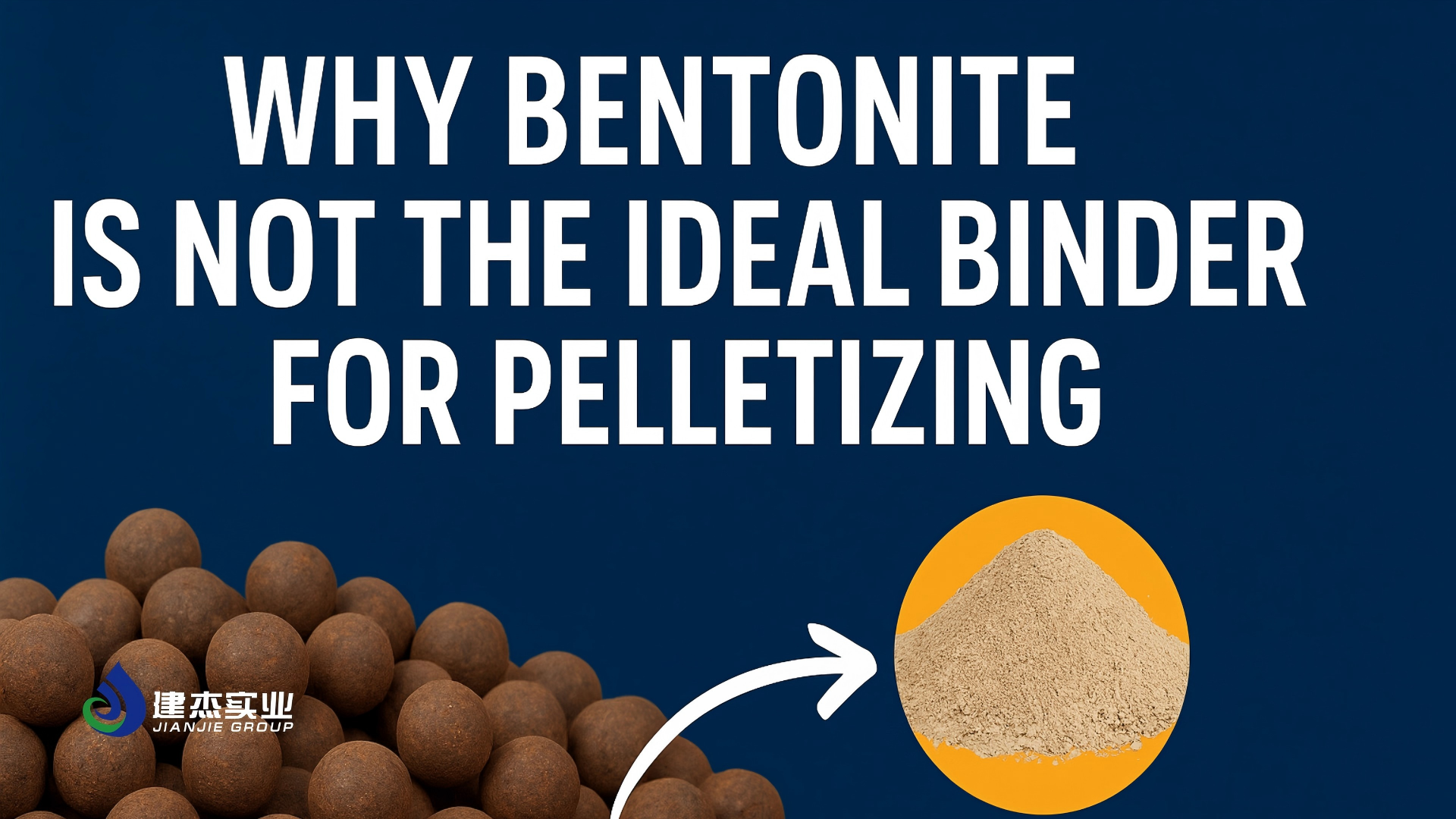
Beyond Bentonite for Higher-Quality Pelletizing with Advanced Binders
Pelletizing plays a critical role in compacting fine iron ore into strong, uniform pellets and, ultimately, high-quality feed for blast furnaces (BF) or direct reduction iron (DRI) processes. The binder is a key factor in determining pellet strength, consistency, and its suitability for downstream metallurgical processes.
Bentonite remains widely used due to its availability and basic binding properties, However, its limitations are increasingly constraining modern pelletizing operations.

bentonite
This article will professionally analyze the drawbacks of using bentonite in pelletizing and present a superior, more cost-effective alternative: Jianjie Iron Ore Pellet Binder Series, designed to elevate both pellets quality and operational efficiency.
In-Depth Analysis: Key Technical Limitations of Bentonite in pelletizing
Bentonite, a clay-based mineral binder widely used in pelletizing, provides basic binding strength through its swelling and adsorption properties. However, under modern high-efficiency production requirements, its performance shows several clear limitations:
Impurity Introduction and Iron Grade Loss
Bentonite adds non-ferrous oxides such as SiO₂ and Al₂O₃ into the pellet, which lowers total iron (TFe) and increases slag generation during smelting—ultimately reducing furnace efficiency and raising fuel consumption.
High Dosage and Added Cost
Due to its low bonding efficiency, bentonite must be added in larger quantities. This leads to higher material and handling costs while also increasing the overall weight of the pellet feed.
Lower Strength and Productivity
Pellets bound with bentonite generally show lower forming strength and a higher breakage rate during drying and handling, which limits productivity and consistency in large-scale operations.
Because of these constraints, steel plants are increasingly turning to advanced organic and composite binders like Jianjie’s binder series, which achieve higher performance with lower dosage and fewer impurities.
What Is Jianjie Pelletizing Binder?
Jianjie pelletizing binderis a series of advanced agglomeration solutions developed specifically for iron ore concentrate pelletizing. Using proprietary organic polymer technology, these binders enable efficient cold or wet agglomeration of fine iron ore particles into high-quality and indurated pellets.

jianjie pelletizing binder
Unlike bentonite, Jianjie’s Iron Ore Pellet Binder introduces ultra-low impurities and provides strong interparticle bonding, even at low dosages, with an addition rate as low as 0.05% This allows steel plants to reduce slag load, maintain TFe grade, and improve mechanical strength throughout the pelletizing process.
Jianjie Iron Ore Pelletizing binder Classification
| Product Series | Application | Chemical Components |
| Organic Binder Series | Magnetite concentratesHematite concentratesMixed iron ore fines and ultra-finesPellet fines recovered from beneficiation or recycling processes | Organic Polymer Blends |
| Composite Binder Series | A Blend of Organic and Inorganic Ingredients |
Comparison of Jianjie Pelletizing Binder and Bentonite
Based on the above overview of bentonite and Jianjie’s Iron Ore pelltizing binder series, the following comparison aims to help you better understand their key performance differences and make an informed decision for your pelletizing process.
| Properties | Jianjie Iron ore pelltizing Binder | Traditional Bentonite |
| Handling Cost | Low handling and logistics cost due to ultra-low dosage | Higher handling and storage cost due to high dosage |
| Forming Rate | High forming rate (≥98%), reducing powder generation and recycled material | Average forming rate (≥90%), generating more powder and returned material |
| Green Pellet Strength | Excellent green pellet strength and drop strength (>6 times at 0.5m); high dry compressive strength (≈50 N or higher) | Low green pellet strength and poor drop strength (≈4 times at 0.5m); lower dry compressive strength (≈30 N) |
| Impurity Content | Contains no impurities such as SiO₂ or Al₂O₃ | High SiO₂ and Al₂O₃ content, increasing slag volume during smelting |
| Iron Grade | Does not reduce the iron grade; pellets maintain high thermal stability and iron content | Reduces iron grade; SiO₂ and Al₂O₃ remain in the pellet after roasting, increasing slag and lowering Fe content |
The above data are based on laboratory tests and industrial application experience under typical operating conditions. Actual performance may vary depending on raw material characteristics, equipment configuration, and process parameters.
As shown in Table, Jianjie pelltizing binder demonstrates significant improvements in pellets forming rate, mechanical strength, and impurity control. The overall enhancement in performance contributes to more stable furnace operation and higher economic efficiency.
Highlights of Jianjie Binders in Pelletizing
Jianjie’s pelltizing binder technology builds upon the foundation of low-impurity, high-efficiency pelletizing established in the previous section. Beyond the clear performance benefits shown in table, several key advantages further distinguish Jianjie binders in both production and metallurgical applications:

pellets
1. High Purity and Grade Protection
Jianjie binders effectively reduce the use of bentonite, lowering SiO₂ and Al₂O₃ content in pellets and preserving higher total iron grades. The formulation is lower phosphorus (P) and sulfur (S), ensuring cleaner pellet chemistry and compliance with strict metallurgical standards.
2. Strength and Durability Enhancement
Both wet and roasted pellets exhibit superior mechanical performance. The binder significantly increases cold and wet compressive strength (CCS and WCS), maintaining burst temperature stability while reducing breakage during handling and drying.
3. Improved Reducibility and Furnace Efficiency
The nature of Jianjie’s formulation promotes greater porosity after induration, enhancing reducibility and supporting smoother, more efficient furnace operations.
4. Tailored Formulation and Proven Reliability
Each binder can be customized to match specific ore characteristics and process conditions. Supported by over 28+patents and more than 40 independent intellectual property rights, Jianjie ensures consistent performance, innovation, and technical reliability across all applications.
The Future of Pelletizing Lies in Smarter Binder Innovation
The limitations of traditional bentonite are becoming unsustainable in today’s highly competitive market. Choosing a binder is not just selecting an additive; it’s choosing a pathway toward higher efficiency, higher quality, and lower operational costs.
The Jianjie pelletizing binder series offers a technologically advanced and economically sound solution for iron ore pelletizing, validated by its advantages in ultra-low dosage, minimal impurity load, high green strength, and superior forming efficiency.
Backed by strong intellectual property rights, we offer customizable binder formulations to precisely match your specific concentrate type (magnetite and hematite) and process requirements.
Experience the difference that technical excellence can make. We invite you to contact our expert team today for a free sample testing service and a detailed consultation.
Frequently Asked Questions About Pelletizing Binders
Q: Why is bentonite still widely used in pelletizing if it has clear limitations?
A: Bentonite has been used for decades mainly due to its low cost, easy availability, and proven performance in early pelletizing systems. However, as ironmaking technologies evolve toward higher productivity and stricter chemical specifications, its drawbacks such as high impurity content and excessive slag generation have now become major bottlenecks for modern pellet production.
Q: How does bentonite affect the iron grade and metallurgical performance of pellets?
A: As a mineral-based binder, bentonite introduces significant amounts of silica (SiO₂) and alumina (Al₂O₃) into the pellet structure. These impurities dilute the total iron grade of the concentrate and increase the slag burden in the blast furnace or DRI unit. The result is higher coke consumption, reduced hot metal yield, and less stable furnace operation.
Q: What are the typical dosage differences between bentonite and Jianjie pelletizing binders?
A: Traditional bentonite binders generally require a relatively high addition rate to achieve adequate pellets strength. By comparison, Jianjie Pelletizing Binders can perform effectively at much lower dosages, in some cases as low as 0.004%,, depending on the characteristics of the ore and process conditions.
This ultra-low dosage significantly reduces raw material costs, simplifies handling and logistics, and improves the chemical purity of final pellets.
Q: Are Jianjie Iron Ore Pelletizing binders environmentally friendly?
A: Absolutely. Jianjie Binders are eco-friendly, non-toxic, and biodegradable.
Unlike mineral-based bentonite, they significantly reduce the introduction of inorganic impurities that increase slag volume. This helps reduce waste, supports green pelletizing processes, and aligns with the steel industry’s goals for low-carbon and sustainable production.
Q: How can I test Jianjie’s binder performance in my plant?
A: We offer laboratory and pilot-scale testing support to help customers evaluate the binder’s performance with their specific raw materials and process parameters.
Our engineers can assist in optimizing binder dosage, moisture control, and pelletizing speed to ensure maximum forming rate and mechanical strength.
-scaled.jpg)

 English
  Arabic
  Chinese
  Russian
  Indonesian