
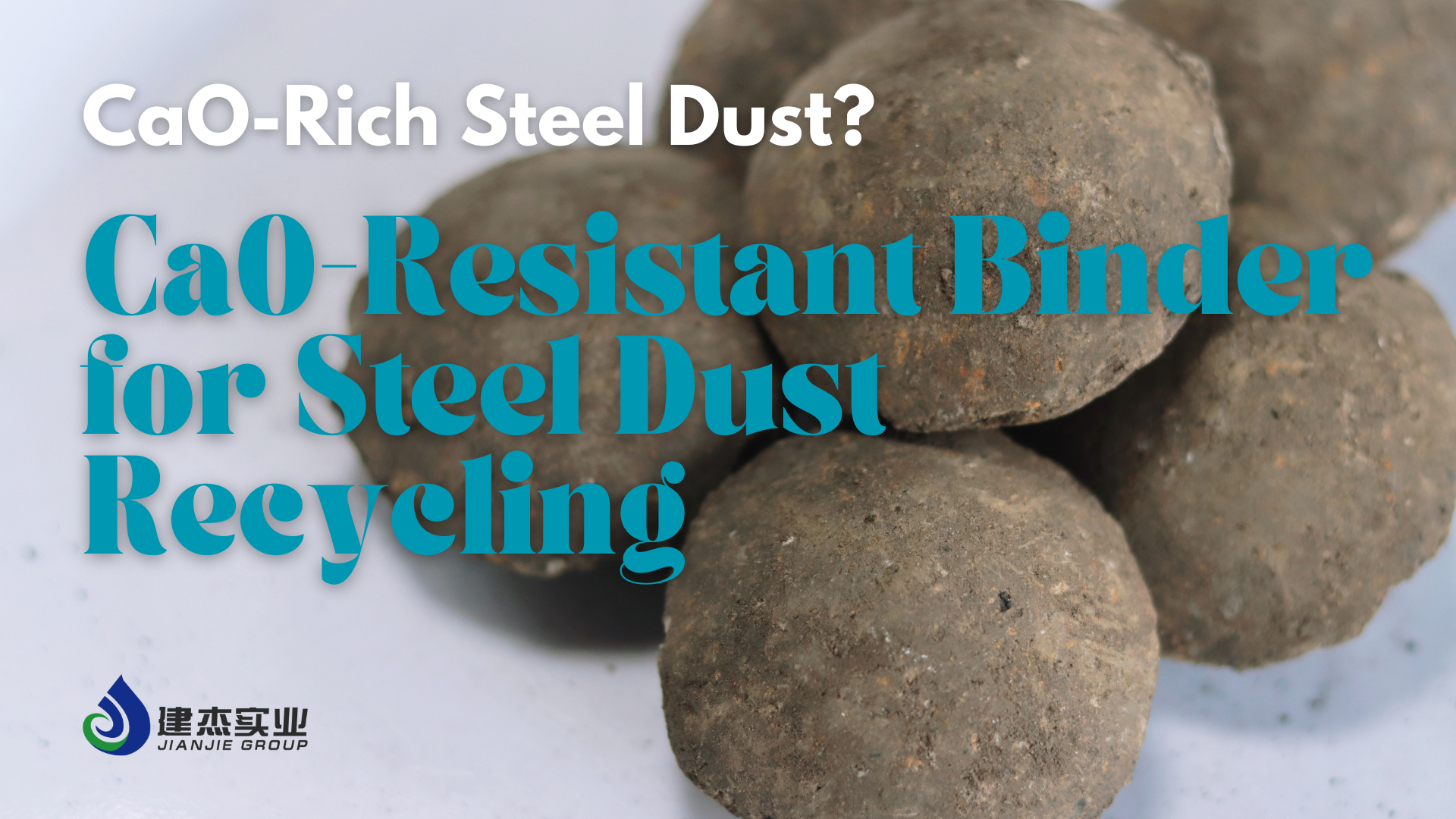
Steel production generates millions of tons of solid waste each year, including steel dust, sludge, mill scale, and slag. Recycling these by-products is a priority for both cost savings and environmental sustainability. One common method is cold briquetting, where fine particles are compacted into briquettes for reuse in blast furnaces, converters, or electric arc furnaces.
However, steel dust briquettes often suffer from a critical weakness: they disintegrate during drying, storage, and transportation. Understanding why this happens — and how to solve it — is essential for steelmakers aiming to improve efficiency and reduce waste.

Why Do Steel Dust Briquettes Disintegrate?
Briquette disintegration is a widely reported issue in doing steel dust recycling. The most common causes include:
Hydration of CaO (Quicklime)
When CaO reacts with water, it forms Ca(OH)₂, which expands significantly. This expansion:
Creates internal pressure in the briquette.
Causes micro-cracks that grow over time.
Leads to loss of cold compressive strength (CCS) and eventual disintegration.
Weakness of Conventional Binders
Briquetting requires binders to hold fine particles together. Yet:
Inorganic binders like cement adds strength but introduces excess silica, increases CO₂ emissions, and is vulnerable to CaO hydration.
Organic binders (such as starch or molasses) lose adhesion when internal stresses rise.
Environmental Conditions
Storage in humid climates or long transportation routes accelerates moisture absorption, which speeds up CaO hydration and briquette failure.
In short: CaO hydration + poor binder choice = unstable briquettes.
How to Know If My Raw Materials Contain CaO?
There are two easy ways to check.
Check the substance components of your raw materials.
Test the pH value of your raw materials. If it’s over pH 7, then it’s possible that there is CaO in your raw materials.
The Science Behind CaO Hydration and Briquette Failure
Many steelmaking by-products contain free CaO. When CaO comes into contact with moisture, it reacts with water:
CaO+H2O→Ca(OH)2
This reaction produces calcium hydroxide, which occupies 1.5–2.5 times more volume than the original CaO. The internal expansion generates micro-cracks inside the briquette, eventually leading to surface spalling, powdering, and complete collapse.
The more CaO raw materials contains, the greater the risk. For example, briquettes made from converter dust or certain types of slag are particularly vulnerable. Without a binder that resists this mechanism, briquetting CaO-rich materials becomes uneconomical.
The Cost of Disintegrating Briquettes
When briquettes crumble before they are introduced to the furnace, steel plants face:
Material loss: fine powder cannot be efficiently charged into furnaces.
Handling problems: cause dust pollution, higher risk of blockages.
Higher operating costs: generate wasted raw materials and added disposal expenses.
Lower recycling rates: reduce ability to reuse valuable iron units.
This is not only an economic issue but also an environmental challenge, since valuable resources end up wasted instead of being recycled.
Why Traditional Binders Fall Short
Many steel plants attempt to use common binders such as:
Bentonite
Molasses
Sodium humate
Carboxymethyl cellulose (CMC)
Carboxymethyl starch
While these materials assist in forming briquettes by providing initial binding strength, they exhibit several limitations when CaO is present:
No resistance to CaO expansion: These binders do not counteract the swelling force caused by CaO hydration. For example binder options like starch, lignosulfonate, or molasses provide initial strength but lose adhesion as CaO expands internally. Their long-term durability in steel dust briquettes is poor.
High dosage requirements: Large amounts of binder are needed to achieve acceptable strength, which increases material costs.
Introduction of impurities: Many traditional binders such as cement and bentonite clay introduce unwanted elements that degrade the metallurgical quality of the briquettes.
As a result, briquettes made with these binders often show poor wet and cold strength, making them unsuitable for high-efficiency steelmaking processes. Furthermore, the increased return rate and reprocessing costs can significantly hurt operational profitability.
How to Solve the Problem: Introducing Jianjie’s CaO-Resistance Binder

Recognizing these challenges, Jianjie developed a CaO-resistance binder technology specifically designed for steel dust with high alkaline oxide content. The key features of this breakthrough binder include:
Compatibility with unreacted or partially digested CaO: It can be used directly with dust that has not undergone complete digestion or hydration.
Low dosage requirement: Only a small amount of binder is needed to achieve high briquette strength.
High binding strength: Briquettes achieve a compressive strength of over 150 kg after dried.
Excellent crack resistance: Effectively prevents cracks, collapse, and powdering even under conditions of high humidity or prolonged storage.
Wide adaptability: suitable for steel dust, bag filter ash, sludge, slag, mill scale, and other CaO-containing by-products.
By using Jianjie’s CaO-resistance binder, steel plants can produce durable, metallurgically sound briquettes without extensive pre-treatment or expensive processing steps, significantly improving the efficiency and economics of dust recycling.
Industrial Applications of Jianjie CaO-Resistant Binder
Jianjie’s CaO-resistant binder has been successfully applied in multiple steel plants:
Converter dedusting ash recycling: briquettes produced with Jianjie binder were reused as fluxing materials, reducing slag additives.
Mill scale and sludge recycling: improved briquette strength enabled furnace reuse, cutting raw material costs.
Economic impact: in one case, steelmaking costs were reduced by lowering the return rate, significantly improving profitability.
These results show that specialized binders are not just technical improvements, but also business drivers for steel companies.
Key Performance Indicators of Jianjie Binder
| Performance Metric | Result |
| Forming rate | ≥ 98% |
| Cold compressive strength | Excellent |
| Environmental compliance | Free of sulfur (S), phosphorus (P), toxic elements |
Summary
In summary, the disintegration of iron-bearing dust briquettes is primarily caused by the hydration expansion of residual CaO, which creates internal stresses leading to cracks and pulverization. Some binders fail to address this fundamental issue, resulting in poor briquette quality and increased operational costs.
Jianjie’s innovative and patented CaO-resistance binder provides an ideal solution by offering strong bonding ability, low impurity introduction, and resistance to CaO-induced stress. In addition to binder products, Jianjie also offers comprehensive consulting and support services, helping steel manufacturers optimize their waste recycling processes and improve overall plant efficiency.
By choosing Jianjie’s solution, companies not only get a better binder — they gain a true technical partner committed to solving real production problems.
FAQs
Q1: Why do steel dust briquettes disintegrate so easily?
Because free CaO in steel dust hydrates when exposed to moisture, expanding up to 2.5× and causing internal cracking.
Q2: Can cement or bentonite solve this problem?
Not effectively. Cement and bentonite add silica and emissions, while some organic binders cannot resist CaO hydration stresses.
Q3: What makes Jianjie binder great for CaO-Containing Steel Dust?
It is specifically designed to resist CaO hydration, providing superior strength, anti-powdering, and environmental benefits.
Q4: Which steel wastes can Jianjie Binder be applied to?
Dedusting ash, converter dust, sludge, mill scale, slag fines, and other CaO-containing materials.


 English
  Arabic
  Chinese
  Russian
  Indonesian